Saint Distaff Day
At this meeting we will be celebrating Saint Distaff Day—also known as Roc Day. We will have a special program allowing spinners to come and spin and for everyone to work on the craft of your choice. Bring your wheels, fibers, projects and equipment of choice.
Distaff Day, also called Roc Day or Rock Day is January 7th, the day after the feast of the Epiphany. It is also known as Saint Distaff’s Day, one of the many unofficial holidays in Catholic nations; But there is no ‘Saint Distaff’. This is yet another example of an ‘unofficial saint’s holiday’ designed to increase the potential for merrymaking. In some Northern European languages, ‘roc’ or ‘rock’ means “distaff.” It originates from an Old English word ‘stæff,’ meaning “staff,” and ‘dis,’ which means a “bundle of flax.” The word was first used around 1000 A.D.
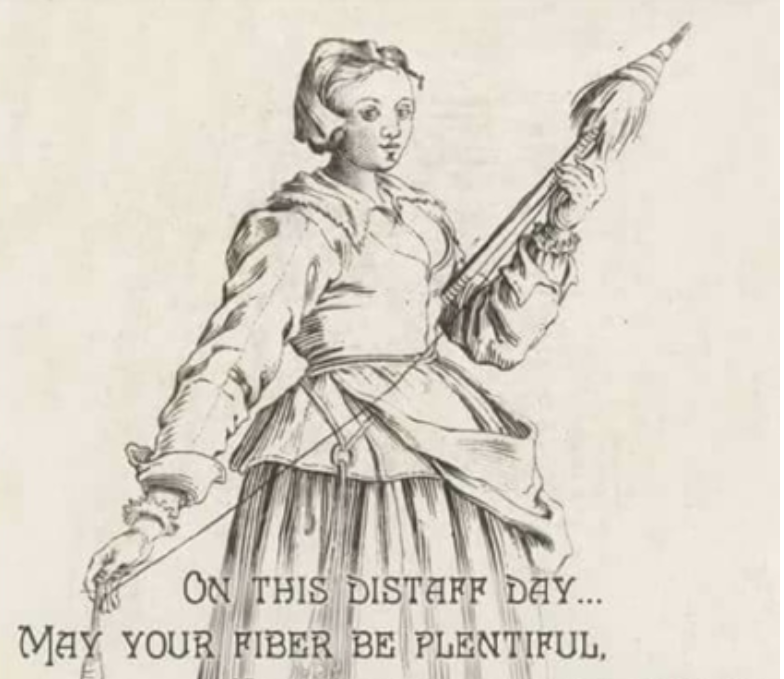
The distaff, or roc, used in spinning was the medieval symbol of women’s work. In many European cultural traditions, women resumed their household work after the twelve days of Christmas. Women of all classes would spend their evenings spinning on the wheel. During the day, they would carry a drop spindle with them. Spinning was the only means of turning raw wool, cotton or flax into thread, which could then be woven into cloth. Men have their own way of celebrating this occasion, called Plough Monday, the first Monday after Epiphany when men are supposed to get back to work. Every few years, Distaff Day and Plough Monday fall on the same day.